Admiring the rare flock of woolly-necked storks returning to Vietnam’s only dry dipterocarp forest
A flock of 9 woolly-necked storks was discovered at Yok Don National Park, marking the largest appearance in the area and contributing to the conservation of this rare bird species.
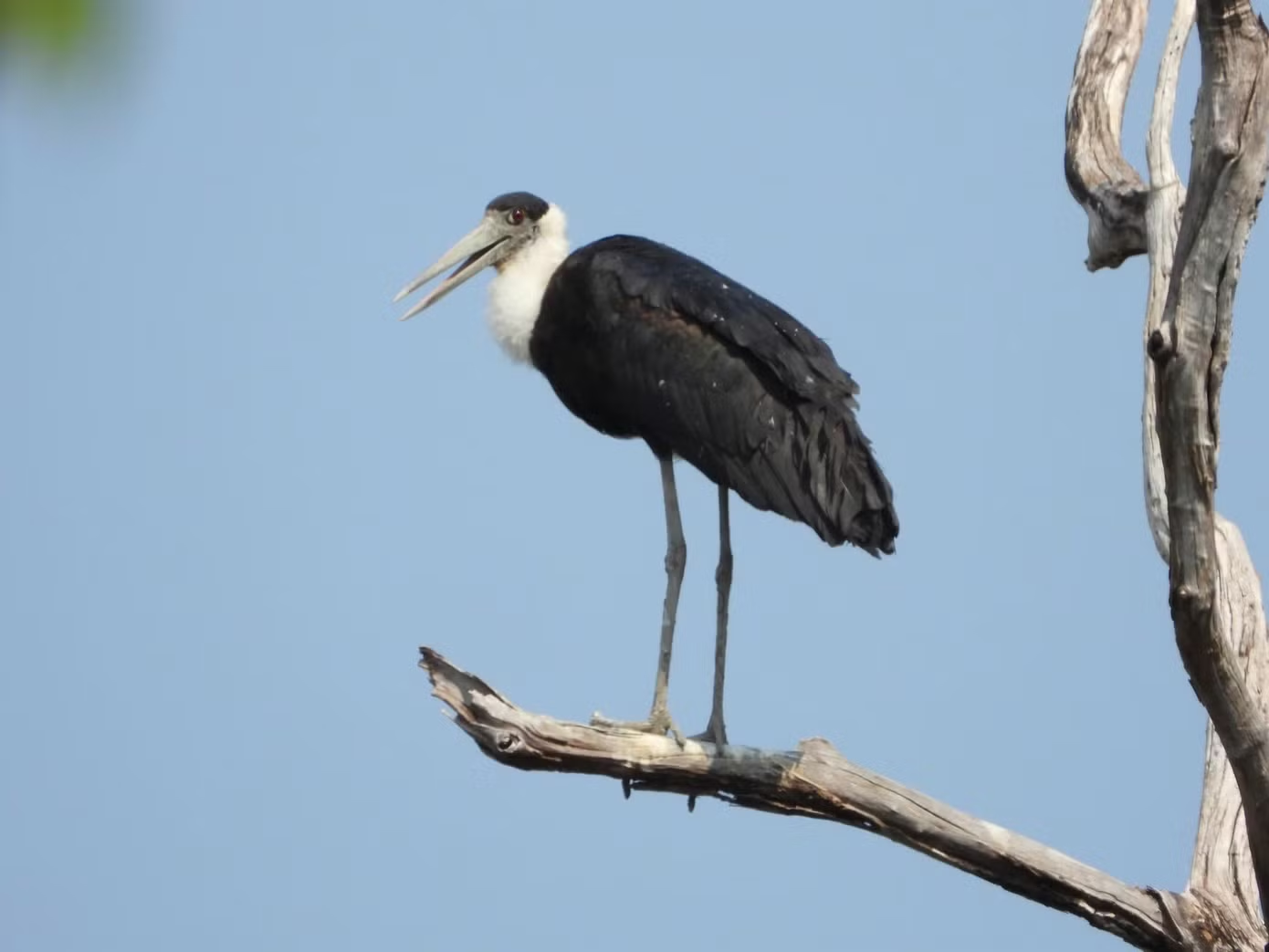
On October 7, according to Mr. Vu Duc Gioi – Deputy Director of the Environmental Education and Service Center, Yok Don National Park, the flock of woolly-necked storks flew into the park’s territory to forage on the morning of October 6. They gathered at a grassy area near the Dak Rang stream within the national park.
Immediately after discovering the flock of birds, the unit directed forces to step up patrols and vigilance to promptly prevent illegal intrusion and hunting.
Mr. Y Siem H’Dok, a guide at the Environmental Education and Service Center (Yok Don National Park), shared that at around 9:00 AM on October 6, while leading tourists on an elephant experience in the dry dipterocarp forest, he unexpectedly spotted the flock of woolly-necked storks.
The flock of 9 woolly-necked storks descended onto the grassy area near the Dak Rang stream in the national park to forage. This is the largest number of woolly-necked storks recorded in this area in recent times.
According to Mr. Y Siem, about 3 months ago, woolly-necked storks also appeared here, but only a few scattered individuals were recorded.
Woolly-necked storks belong to Group IB, a group of forest animals facing severe threats of extinction, prioritized for protection and strictly prohibited from exploitation and use for commercial purposes.
The average height is from 75-92cm. The most distinctive feature is the neck covered with a soft, white downy layer of feathers that fluff up like a cotton strip. The crown of the head has a black “cap”, and the entire body and wings are black with a shimmering purple or green sheen.
In Vietnam, woolly-necked storks have been recorded appearing sporadically in several nature reserves and national parks in the South and the Central Highlands (such as Yok Don National Park, Ma Da Nature Reserve).
The behavior of woolly-necked storks is usually solitary, in pairs, or in small family groups (rarely gathering into large flocks). Their food consists of small fish, frogs, reptiles, large insects, crabs, snails, and aquatic invertebrates.
Yok Don National Park has a rich flora and fauna system with more than 1,000 plant species, 650 animal species including 92 mammal species, 55 reptile species, over 370 bird species, and nearly 440 insect species.
Among these animals, more than 40 mammal species, over 20 bird species, and several rare reptile species are listed in the Vietnam Red Data Book. Notably, among the more than 370 bird species, there are endemic birds of the dry dipterocarp forest.
Reference source: tienphong.vn
TIN BÀI LIÊN QUAN
Culinary Flavors Along the Roads of Myanmar
Amidst a life still filled with hardships, the streets of Myanmar captivate travelers with deeply endearing colors. These include the warm smiles on old…
Hang Rai, Khanh Hoa – Nature’s Miraculous Masterpiece
Once likened to "Mars on the shore," Hang Rai impresses visitors with millions of years old ancient coral rock formations and the phenomenon of…
Breathtaking Sunset Over the Wind Farm
Under the brilliant golden sunset, the wind turbines in Khanh Hoa emerge in a mesmerizing way, turning this sun-drenched and windy land into an…
Rare Blue-winged Pitta spotted in Hanoi
Amidst the bustling urban landscape, a Blue-winged Pitta—a rare forest bird with vibrant plumage—unexpectedly appeared, hopping and climbing in Hanoi, delighting many observers. This…
Wild birds ‘settle down’ at Hoan Kiem Lake, gracefully gliding and hunting in front of visitors
Hundreds of wild birds have unexpectedly gathered at Hoan Kiem Lake to nest and hunt. Amidst the vibrant colors of the changing seasons, the…
A magical sea of clouds over the sky of Nha Trang
Breakfast in Nha Trang suddenly turned into… a surreal film. The coastal city, usually familiar with golden sunshine, was now covered by a floating…
BÌNH LUẬN
Bình luận đang tắt cho bài này. Có thể bật trong phần Thảo luận của bài viết.